
You may think of blood as just some gruesome red liquid under your skin but it's vital for all life. If you stretched out all your blood vessels it would be over 100,000 miles. To give you some perspective, that could circle around the Earth four times.
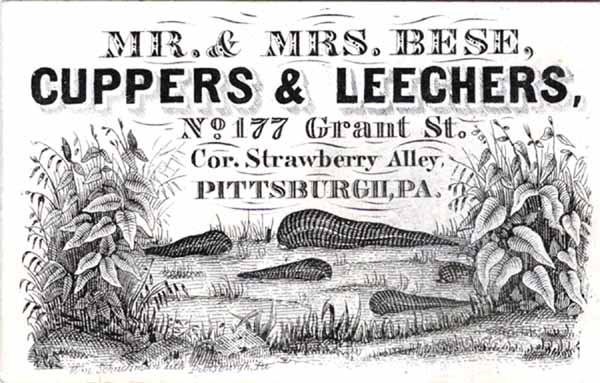 |
| This couple had a little business going |
was fascinating and well written. It basically gives you a summary about the entire history of blood. From what blood consists of – plasma, red blood cells, white blood cells, hemoglobin, water, and platelets – to the people that discovered the importance of blood. Ibn al Nafis, an Egyptian scientist, discovered that the heart was a pump that kept blood flowing throughout your body. It took the Europeans another 300 years to make the same discovery. A lot of people used to think bloodletting was a way to balance out the biles in your blood. They used to cut your arteries and and take pints of blood at a time. Sometimes if they thought the area was to delicate to cut, like your face or temples, they'd use leeches that would detach from your skin when filled with blood, about five times as big as they started. The only reason that this would ever work to cure anything was the loss of blood woud make you weak, making you sleep which is the best cure for sickness, making the success rate of bloodletting a little higher than nothing. People started to doubt bloodletting when it killed our first president, George Washington. He was soaked when coming back from a horse ride and neglected to take off his wet clothing and got sick. He could've just slept it off but he insisted on bloodletting. His doctor drained five pints which is more than half the blood in your body. Of course it killed him.

Most animals including humans have a circulatory system but some animal's blood just kind of sloshes around under their skin. A cockroach can survive weeks with its head cut off because its blood just sloshes around in its body. If its head comes off, a scab immediately forms to keep the blood in and for the most part it can go about its life again.
Do not mess with the horn lizard. When it's threatened it shoots blood from its eyeballs into the face of its attacker. Apparently the blood tastes horrible because it sends the attacker running and the lizard is left unharmed.

Hematophagous animals feed on blood to survive. One hematophagous is the female mosquito who can actually be deadly because they're disease carriers. Mosquito saliva has both a numbing agent that keeps you from feeling your skin being pierced and an anticoagulant that keeps your blood from clotting. Mosquitos carry blood-borne diseases. They kill more than a million people each year yet they aren't affected by the diseases they carry. But one of the most sneaky hematophagous is the vampire bat.
Overall, I learned a TON from "The Book of Blood" and recommend it for people who like non-fiction and people that always read fiction and want to read a non-fiction book that's about as close as you can get to fiction. Enjoy It!

